
In the case of general inquiries, contact Prof. Vesselin Paunov, the department chair.
Students in the Ph.D. in Chemistry program are required to complete 240 ECTS credits, within a normal timeline of 4 years, which is in line with the Regulatory Framework for Graduate Programs and Courses of Nazarbayev University (2019).
The program consists of comprehensive coursework and research activity. The courses are designed to enable students to acquire highly advanced and cutting-edge knowledge in Chemistry. Additional, flexible learning time allocated into their research program would enable them to attend specialized equipment training courses and gain practical skills in working with Nazarbayev University core facilities, essential for their research projects. After passing a comprehensive exam and Ph.D. proposal defense, students are required to develop and practice novel research within the area of Chemistry, or an interdisciplinary field related to Chemistry. Research components of the program and dissertation defense will be passed by each student to complete the program and graduate.
- Design research proposals in their area of expertise and execute research projects, resulting in preparation of coherent reports of research findings and possible research publications;
- Demonstrate knowledge of the concepts of experimental and theoretical chemistry, complete successfully in both core and elective courses;
- Search, discover, and master contemporary research literature in their field of expertise, including their research project and develop awareness about its commercialization potential.
- Apply research methodology in successful execution of experiments in a research laboratory or implement analytical and/or numerical solutions of a scientific question related to unsolved Chemistry research problems;
- Employ knowledge of the phases and stages of the research process through successful presentation of a research seminar and/or proposal writing;
- Explain scientific concepts and research findings through various modalities of communication in English, with particular emphasis on tertiary education instruction.
During the first year, students' complete core and elective courses to build foundational knowledge and research skills. Students may choose from one of three study options to align their coursework and research focus:
- Chemistry with Nanotechnology
- Chemistry with Environmental Science
- Chemistry with Drug Design
Core courses (30 ECTS)
Students are required to complete two compulsory courses: Research Methods & Ethics and Hot Topics in Chemistry (which includes research orientation and supervisor selection). In addition, they select three out of five departmental core courses (24 ECTS) based on their chosen study option. The available core courses include:
- Advanced Medicinal Chemistry
- Chemical Thermodynamics and Kinetics
- Mechanistic Principles of Organic Reactions
- Modern Inorganic Chemistry
- Polymer Chemistry
- Spectrochemical Methods of Analysis
Elective courses (32 ECTS)
Electives deepen expertise in the chosen study option and support research and career development. All electives include advanced assessments such as scientific presentations, literature reviews, and poster sessions. Sample elective courses include:
- Advanced Environmental Chemistry
- Colloid and Surfactant Science
- Design of Functional Materials
- Machine Learning in Cheminformatics
- Materials Chemistry
- Membrane Science and Technology
- Organometallic Chemistry
- Pharmaceutical Chemistry and Drug Design
Research courses (178 ECTS)
Research begins early and continues through the first semester of Year 4. Students must pass a comprehensive exam by the end of Year 1 before defending their Ph.D. proposal. The final semester is dedicated to doctoral research and thesis defense, demonstrating an original contribution to the field.
- An international mobility period (6–12 months) may be included to gain global research experience. A fifth-year extension is possible with approval and specific conditions.
FALL SEMESTER (32 ECTS)
CHEM 7XX - Graduate Core Course 1* (8 ECTS)
CHEM 7XX - Graduate Core Course 2* (8 ECTS)
CHEM 7XX - Graduate Core Course 3* OR Graduate Elective Course 1 (8 ECTS)
CHEM 700 - Hot Topics in Chemistry (8 ECTS)
CHEM 798 - Thesis Research (Continuous course in research)
SPRING SEMESTER (30 ECTS)
CHEM 780 - Research Methods and Ethics (6 ECTS)
CHEM 7XX - Graduate Core Course 3* OR Graduate Elective Course 1 OR 2 (8 ECTS)
CHEM 7XX - Graduate Elective Course 2 (8 ECTS)
CHEM 7XX - Graduate Elective Course 3 OR Technical Elective (8 ECTS)
CHEM 798 - Thesis Research (Continuous course in research)
In the summer, students will take a comprehensive exam that covers two core Chemistry courses as well as two elective Chemistry courses selected by both the supervisor and the student. Successful completion of this exam will make them eligible to defend their proposal, typically scheduled for the fall semester of their second year.
From the summer of their first year through the fall semester of their fourth year, students are required to enroll in CHEM 798 (Thesis Research). In the spring semester of their fourth year, students have the option to enroll in CHEM 800 (Doctoral Thesis) to defend their thesis or may choose to continue with CHEM 798, subject to approval by their supervisory committee.
Legend:
* course may be waived for NU students and can be replaced by an elective course
** Technical elective can be a non-Chemistry course selected from post-graduate elective courses offered at SSH (Biology, Physics, Mathematics), NUSOM (Biomed), SEDS (Chem. Eng.) subject to agreement with the supervisory committee.
This course introduces the students to specialized modern topics in physical, materials, organic and inorganic chemistry which are at the forefront of this discipline. The course will not only to give students a comprehensive overview of many modern areas in physical, inorganic, organic and materials science, but also to present them with some current challenges and perspectives in these fields.
The course will be delivered by 7 cycles of multidisciplinary lectures from 7 Chemistry faculty members, specific to their research interests, and covering broad topics from:
(i) Applied nanotechnologies,
(ii) Theoretical and computational approaches to design of functional and photoactive materials,
(iii) Modern aspects of applied catalysis,
(iv) Molecular spectroscopy and characterization of nanomaterials,
(v) Advanced methods of surface analysis,
(vi) Materials for sensing, environmental and biomedical applications,
(vii) Multicomponent reactions for synthesis of functional bioactive materials and natural products.
This course explores relationships between organic chemical structures and their reactivity. Students will learn the key theoretical models developed to rationalize the reactivity of various functional groups and reactive intermediates. A particular emphasis will be given to acquiring the solid knowledge of computational, spectroscopic, kinetic and isotope labelling approaches for the mechanism elucidation. The course will be delivered through the structured independent online learning coupled with interactive problem-solving workshop sessions, where mechanisms of specific reactions such as substitutions, additions to multiple bonds, pericyclic reactions, free radical and photochemical reactions as well as molecular rearrangements will be discussed from various prospects aiming to develop broad principles governing various organic reactions.
CHEM 711 Polymer Chemistry
This is a comprehensive polymer science course which is designed to provide students with the fundamental knowledge on high molecular weight polymeric materials of both natural and synthetic origin, their properties, synthesis, functions, as well as applications, in particular in the pharmaceutical and biomedical fields. This course enables increasing students’ competence and practical knowledge on concepts of polymer chemistry required for better understanding processes and mechanisms at the core of advanced topical research of any Life Science related discipline. The first half of the course will be focusing on fundamental aspects of polymer chemistry, while the second half will be providing closer insights on polymers for pharmaceutical and biomedical applications.
CHEM 720 Spectrochemical Methods of Analysis
General concepts of encoding chemical information as electromagnetic radiation; major instrumental systems for decoding, interpretation, and presentation of the radiation signals; atomic emission, absorption, and fluorescence; ultraviolet, visible, infrared, and microwave absorption; molecular luminescence; scattering methods; mass spectrometry; magnetic resonance; automated spectrometric systems. The course is concurrent with the MSc course CHEM 520 Applied Analytical Chemistry with additional course work for the PhD students.
CHEM 722 Advanced Environmental Chemistry
The course provides an integrated description of the chemical processes and equilibrium systems that determine mobility, transport, turnover and effects of chemical contaminants in air, soil and water. It also provides an introduction to natural chemical processes in the environment. The course is concurrent with the MSc course CHEM 522 Analytical Environmental Chemistry and the BSc course CHEM 471 Environmental Chemistry and will be delivered with additional course work for the PhD students.
CHEM 723 Membrane Science and Technology
This PhD level course will cover all basic principles of membrane science and the corresponding membrane technologies processes. A brief introduction to the historical development of membranes and membrane processes will be given. Membrane structures and the functionalities developed for specific processes will be covered. The transport principles for porous and non-porous membranes (viscous flow, Knudsen diffusion, Fick's law, solution/diffusion) will be discussed in great detail with respect to their driving forces and how this knowledge can be applied to design advanced membrane materials/structures. A large fraction of the course will be dedicated to materials sciences aspects required for the development of advanced membranes for individual process types. General analytical techniques to evaluate membranes will be introduced for gas permeation, gas sensors, and water purification membranes, followed by a series of lab demonstrations, thus, the course prepares students for independent research.
CHEM 731 Design of Functional Materials
The course provides a graduate level overview of modern atomistic computer simulations used to model, understand and predict properties of technologically important materials. The emphasis is on practical use of techniques, algorithms and programs to bridge theory and applications, from the discovery of materials to their use in real-world technologies. Several laboratories give students direct experience with simulation methods as well as practical knowledge on how to use computational modeling and how to present and interpret results of simulations. Bridges from atomic to complex systems demonstrate potential of different theories to applications relevant to multiple major industries in the future, including nanotechnology and energy. The course is concurrent with the MSc course CHEM 511 Theoretical Chemistry and the BSc course CHEM 431 Computational Chemistry and will be delivered with an additional course work for the PhD students.
CHEM 732 Machine Learning in Cheminformatics
This PhD-level course focuses on applying machine learning techniques to solve complex problems in cheminformatics, particularly in molecular modeling, drug discovery, and chemical property prediction. Key topics include deep learning, support vector machines, and reinforcement learning for molecular simulations, virtual screening, and chemical structure-property relationships. Students will gain hands-on experience in developing and optimizing machine learning models to analyze large chemical datasets, integrate computational chemistry tools, and improve prediction accuracy. The course prepares students for independent research and application of machine learning in both academic and industrial contexts. The course is concurrent with the MSc course CHEM 512 Cheminformatics and the BSc course CHEM 432 Introduction to Cheminformatics and will be delivered with additional course work for the PhD students.
CHEM 733 Colloid and Surfactant Science
This is a comprehensive materials science course which is designed to increase the student’s competence and practical knowledge required to work in formulation science and technology projects. The fundamental background given by the course allows better understanding the basic principles which underpin the successful formulation of a range of consumer and industrial products. The course contains two parts, related to fundamental properties of (i) surfactants and (ii) colloids.
CHEM 740 Advanced Medicinal Chemistry
This course is designed to provide students with an advanced understanding of medicinal chemistry, focusing on the drug discovery and development process. Topics include structure-activity relationships, pharmacokinetics, and modern computational approaches such as molecular docking and QSAR. The course also explores synthetic methodologies, drug design strategies, and the role of enzymes and receptors in therapeutic development. Students will learn to utilize specialized software, analyze recent advancements, and address ethical considerations in medicinal chemistry research. At the end of the course, students will prepare a detailed research proposal and review paper in Medicinal Chemistry.
CHEM 741 Advanced Pharmaceutical Chemistry
This doctoral-level course offers a comprehensive and critical examination of therapeutic agents directed against infectious and neoplastic diseases. It encompasses advanced analysis of mechanisms of action, molecular resistance pathways, and structure–activity relationships of major antibacterial, antiviral, and anticancer drug classes, as well as their delivery routes and strategies. Strong emphasis is placed on rational drug design principles, state-of-the-art computational and AI-driven methodologies, drug delivery system design and evaluation of landmark case studies. The course is designed to train students to synthesize current knowledge, critically assess cutting-edge literature, and formulate original strategies for the discovery and development of next-generation therapeutics.
CHEM 750 Modern Inorganic Chemistry
This course is concurrent with CHEM 530 – Inorganic Structures and Reaction Mechanisms and is designed to prepare students for further research in Inorganic Chemistry and, more generally, employment is physical or materials sciences fields. The course includes advanced concepts in structure, bonding, and chemical/physical properties of inorganic compounds, understanding of which is central to the study of all areas of chemistry. In addition, the course covers the synthesis, structure, bonding, reactivity, and applications of coordination compounds. The primary emphasis will be on the fundamental reaction types, mechanisms of such reactions, methods for studying them and their relevance to important processes in industrial catalysis and synthetic chemistry.
CHEM 752 Materials Chemistry
Our technology-driven world is fueled by advances in materials chemistry with examples of application in areas such as microelectronics, sensors, catalysis, and energy technology. This course provides an overview of materials chemistry with a particular emphasis on the correlation between materials structure and their properties. In the framework of the course, we will discuss how different classes of materials are produced, why they exhibit some specific properties, and how these properties are applied in industry and manufacturing. In particular, the course covers synthesis and detailed discussion on how molecular structure and crystallinity of materials can be related to electronic, optical, magnetic, mechanical, and other useful physicochemical properties of materials.
CHEM 753 Organometallic Catalysis
This course is concurrent with CHEM 451 – Applied Homogeneous Catalysis and CHEM 532 – Organometallic Chemistry and aims to teach students the concepts in modern organometallic chemistry with an emphasis on applications of organometallic compounds in synthetic chemistry and important catalytic transformations, relevant to petroleum and chemical industries, including the synthesis of commodity and specialty chemicals. The course covers synthesis and bonding in organometallic complexes, fundamental reactions and their mechanisms, thermodynamic and kinetic considerations of complex formation, stability and reactivity, and applications of organometallic compounds to synthetic chemistry and catalysis. The later includes in-depth analysis of mechanisms of catalytic reactions, methods for catalyst separation and challenges in applying organometallic catalytic systems in industrial setting.
CHEM 780 Research Methods and Ethics
This course is designed to help students develop scientific writing skills. It provides an understanding of scientific methods and ethics, as well as practical aspects of statistics, experimental design, research methodology, laboratory safety, and bibliographic databases; in particular, the use of Reaxys, SciFinder Scholar, and other scientific databases, as well as specialized chemistry software such as ChemDraw and others. At the end of the course, students will be required to write a research paper in their chosen field.
CHEM 789 Thesis Research
This course is designed to monitor progress and develop understandings, skills, and outlooks to conduct original, independent research at the Ph.D. level. The student will develop (with the advisor’s guidance) a research plan at the beginning of the semester that will state a research problem/question/hypothesis, its background, outline a research strategy and experimental approach, method of data collection, interpretation and validation, and method of communication of the project results to others. The research plan is used as the basis for assessment of the student’s research progress.
CHEM 800 Doctoral Thesis
This course is designed to facilitate before the end of the prescribed program period or approved degree deferral period the writing and submission of the doctoral thesis for review by the thesis examiners. The thesis must be completed according to the Format and Style Guidelines of the Chemistry Department.
As you may know, Nazarbayev University is well-known for its commitment to quality in research and education, and it provides cutting-edge facilities and resources to facilitate advanced study in Chemistry. Furthermore, the university's emphasis on interdisciplinary collaboration provides students with unique opportunity to interact with researchers from many fields, encouraging innovation and creativity.
Since joining as an international PhD student in 2022. i have had the privilege of being part of a diverse and dynamic community of scholars and professors, and this environment fostered my dedication and commitment to achieving scientific excellence.
My current research focuses on the Design and Fabrication of Charged Polymeric Membrane Matrices for Enhanced Ion and Molecular Separations. I am engaged in the development and evaluation of advanced membrane systems for environmental and energy-related applications, including oil/water separation, water purification, and ion–ion separation processes. Through this research, I am developing strong experimental, analytical, and problem-solving skills. During my PhD studies, I have actively participated in several international conferences and have been fortunate to receive academic awards.
I would like to express my sincere appreciation to my research supervisor, Professor Irshad Kammakakam, for his outstanding mentorship and leadership. Under his supervision in the Materials for Energy and Environmental Technologies (MEET) Lab, I am involved in impactful research on advanced organic porous materials and functional polymeric membranes aimed at energy-efficient and environmentally friendly separation technologies.
This ongoing PhD journey continues to strengthen my confidence as a researcher and reinforces my commitment to contributing meaningful scientific solutions to global energy and environmental challenges.
Read the Instructions about the application procedure given in your Personal account.
- In your Personal account, go to the “My Application Forms” section and click on the link on Step 1. Complete the Application Form, including the Consent Form for personal data processing, and click “Upload”.
- Proceed to Step 2 to upload the required documents in the specific format.
- Upload a 3×4 photo to the “Profile” section.
- To finalize your application, click the “PAY AND SUBMIT APPLICATION” in the “My Application Forms” section of your Personal account. The application fee must be paid online using the only available payment options; no other payment methods are accepted.
- You may apply for up to 2 Master’s or PhD programs but if accepted into both, you must choose one.
- The regular application fee is 15,000 tenge, and the late application fee is 45,000 tenge. The late application period is considered to be the last two weeks before the initially established application deadline. The application fee is non-refundable, regardless of the application outcome or any payment errors.
- After submission, you cannot make any changes.
1. Electronic Submission:
- Send the electronic results of your valid IELTS/TOEFL/GRE/GMAT certificates directly to NU by the Test Administrator.
- Upload a scanned copy of your IELTS/TOEFL certificate and enter its unique number in the “Upload IELTS/TOEFL results” section of your Personal account. You can upload multiple certificates, but only the most recent one will be considered.
- Upload a scanned copy of your GRE/GMAT certificate in the “My Application Forms” section (Step 2) when submitting your documents (if required).
- IELTS: NU, Admissions Department
- TOEFL iBT: 6762
- GRE: 6496
- GMAT: H6M-R7-93
- NU is not responsible for submitting your test results. You must contact the Test Administrator (Test Center) independently to send your certificate, which takes at least 7-10 working days.
- Results received after the deadline will not be considered.
- All certificates must be valid at the time of application submission.
- Detailed instructions for submitting IELTS/TOEFL certificates are available in your Personal account.
- IELTS Online, TOEFL iBT Home Edition, and TOEFL PDT results are not accepted.
- Video instructions on how to upload your IELTS/TOEFL results can be found here.
You may be exempt from providing IELTS/TOEFL if:
- You earned a degree in a country where English is the official language.
- Your undergraduate or graduate degree was taught in English (confirming document required).
- You are a graduate of NU.
Regularly check your email and Personal account for updates about your application status, and remember to check your spam folder, as emails from the University may end up there.
If invited, attend the interview with the Admissions Committee, which will be conducted in English.
If you have any issues with the application, email phd_admissions@nu.edu.kz with a detailed description of the problem, your IIN (for citizens of Kazakhstan) and your Applicant ID number.
1 | Undergraduate and Master's degrees (or equivalents) | During the application period, final year master's students may submit an official transcript for current coursework for consideration; A minimum CGPA of 2.75 out of 4.00 in an applicant’s Master’s degree. For PhD in Eurasian studies program, a competitive CGPA in an applicant’s Master’s degree. |
2 | High level of English proficiency | 1. Overall IELTS test score of 6.5 (with sub-scores no less than 6.0) or the equivalent TOEFL score as posted on the ETS website. For PhD in Eurasian Studies program, overall IELTS test score of 7.0 (with sub-scores no less than 6.0) or the equivalent TOEFL score as posted on the ETS website. TOEFL iBT Home Edition, TOEFL PDT, IELTS Online and IELTS Indicator results are not accepted; 2. Applicants can be exempted from submitting the language proficiency test report if: – One of their earlier academic degrees was earned in a country where English as the language of official communication and academic instruction; – An undergraduate and/or graduate degree was earned in a program officially taught in English; |
3 | Strong reading, analytical, and mathematical skills | As demonstrated by GRE test (recommended); |
4 | Personal statement | A high level motivation and a strong interest in the Program, as outlined in a statement of purpose. |
5 | Strong academic writing ability | For PhD in Eurasian studies program only, strong academic writing ability as demonstrated in a writing sample (academic paper, essay, published article); |
6 | Research proposal | For PhD in Eurasian studies program only, relevant research interest and knowledge of research subject as demonstrated in a written research proposal. |
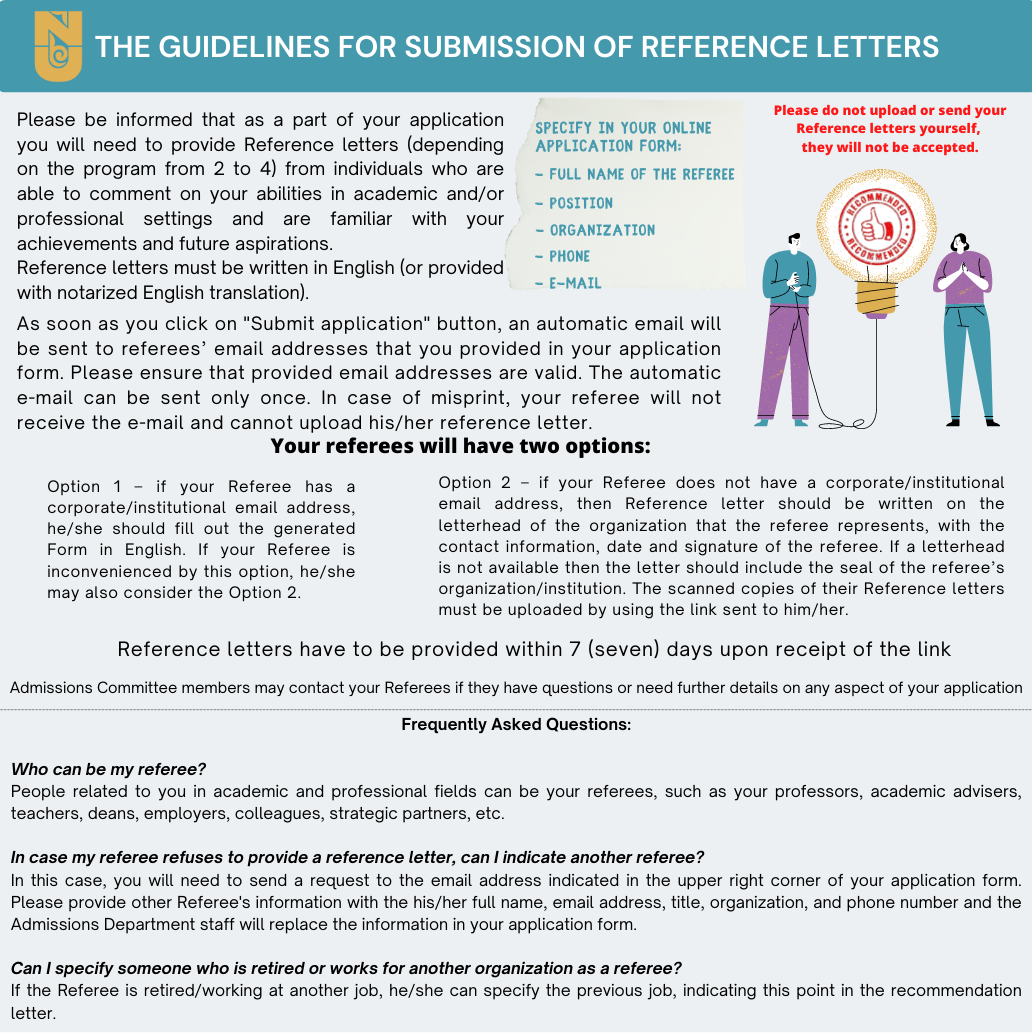
7 | Letters of recommendation | Two confidential letters of recommendation written within the last 12 months (to be provided by referees electronically or in hard copy). You can find the Instructions for submission of recommendation letters here; |
8 | CV | A CV up to 1 page. |
Minimum requirements:
1) Undergraduate and Master's degrees (or equivalents). During the application period, final-year master's students may submit an official current transcript for consideration;
2) A minimum CGPA of 2.75 out of 4.00 in an applicant’s master’s degree. The Admissions Committee can consider the graduates of highly ranked universities with CGPA of 2.5 out of 4.0;
3) English proficiency:
3.1) Overall IELTS test score of 6.5 (with sub-scores no less than 6.0) or the equivalent TOEFL score as posted on the ETS website. For the PhD in Eurasian Studies program, overall IELTS test score of 7.0 (with sub-scores no less than 6.0) or the equivalent TOEFL score as posted on the ETS website.TOEFL iBT Home Edition, TOEFL PDT, IELTS Online and IELTS Indicator results are not accepted;
3.2) Applicants can be exempted from submitting the language proficiency test report if:
- one of their earlier academic degrees was earned in a country with English is the language of official communication and academic instruction;
- an undergraduate and/or graduate degree was earned in a program that was officially taught in English;
4) Strong reading, analytical, and mathematical skills as demonstrated by GRE test (recommended);
5) A high level of motivation and strong interest in the program as outlined in a personal statement;Application package checklist:
All submitted documents shall be in English or with notarized English translation:
- Complete Application form;
- Scanned copy of national ID (for the citizens of the Republic of Kazakhstan) or passport (for international applicants);
- Scanned or electronic copy of an official document confirming name change (if applicable);
- Degree diplomas (Bachelor’s and Master’s or equivalents) with transcripts; During the application period, final year master's students may upload official current transcript for consideration;
- An official electronic IELTS/TOEFL certificate (valid at the time of document submission) sent to the University through IELTS/TOEFL VERIFICATION SERVICES. Code for IELTS: NU. Code for TOEFL: 6762;
- Document confirming English as the language of instruction (only for applicants who earned their degree in a program which was taught in English and request an exemption from submitting IELTS/TOEFL). Applicants should provide a detailed certificate/reference from the university indicating the number and list of subjects completed in English;
- GRE or GMAT certificates valid as of date of online documents submission (recommended);
- Statement of purpose - A high level motivation and a strong interest in the Program, as outlined in a statement of purpose.
- Two confidential letters of recommendation written within the last 12 months (to be provided by referees electronically or in hard copy). One of the two recommendations shall be written by a current or previous employer or research supervisor. You can find the Instruction for submission of recommendation letters here;
- CV (up to one page).
Deadline for full tuition fee-paying applicants:
- For international applicants with visa required prior to arrival: June 1, 2026, 2 pm (Astana time);
- All other applicants (local and international): July 17, 2026, 2 pm (Astana time).
- for international applicants: March 17, 2026;
- for the citizens of the Republic of Kazakhstan: March 30, 2026.
The deadline for submission of IELTS/TOEFL, GRE/GMAT certificates:
For full tuition fee-paying category:
- For applicants from countries requiring a visa prior to arrival: June 1, 2026;
- For other applicants (local and international): July 17, 2026.
- for international applicants: March 17, 2026;
- for the citizens of the Republic of Kazakhstan: April 8, 2026.
First day of classes: August 2026
To learn more about tuition fees, please contact us at bursars_office@nu.edu.kz.
There are merit-based “Abay Kunanbayev” scholarships for top international applicants recommended for admission.
Take the first step.
Fill out the form to start the conversation, and one of our program specialists will follow up with you directly. You'll also receive a link to download our guides and program information emails.