
In the case of general inquiries, contact Prof. Anton Desyatnikov, the department chair.
The Ph.D. program in Physics especially focuses on priority areas for Kazakhstan, serving as a foundation for future high-tech industries and a knowledge-based economy. By the completion of the PhD program, students will be capable of designing and conducting independent, innovative, original and high quality research on a variety of topics in Physics as well as interdisciplinary topics.
In addition, program graduates will be prepared for working in industrial and academic environments including positions of university faculty members, senior researchers, high-tech entrepreneurs, engineers, product developers and science & technology policy makers.
List of L-9 graduate elective (and core) courses for PhD in the Department of Physics
Offered by the Physics Department (PHYS):
- PHYS 700 Thesis Research*
- PHYS 701 Current Research Literature
- PHYS 705 Classical Mechanics*
- PHYS 710 Quantum Mechanics*
- PHYS 711 Computational Modeling and Simulation
- PHYS 715 Classical Electrodynamics
- PHYS 720 Statistical Physics
- PHYS 750 Advanced Mathematical Physics\
- PHYS 774 Lasers and Photonics
- PHYS 730 Condensed Matter Physics
This course is designed to monitor progress and develop understandings, skills, and outlooks to conduct original, independent research at the PhD level. The student will develop (with the advisor’s guidance) a research plan at the beginning of the semester that will state a research problem/question/hypothesis, its background, outline a research strategy and experimental approach, method of data collection, interpretation and validation, and method of communication of the project results to others. The research plan is used as the basis for assessment of the student’s research progress.
Classical mechanics can be seen as a fundamental course in mathematical physics. In this course, students will learn to apply the laws of classical mechanics to the situations requiring an advanced level of mathematical treatment developing the theoretical foundations for ideas such as symmetries and conservation laws. The methods and concepts developed are of direct relevance to advanced studies and research in many areas of modern Physics such as Quantum Mechanics, Statistical Mechanics, Continuum Solid and Fluid Dynamics, Solid State Physics, General Relativity, etc. The relevant mathematical background is to be introduced in the course when required. The course covers Newton’s Laws, Oscillations, Central Motion, Calculus of Variations, Lagrangian and Hamiltonian Dynamics, Canonical transformations, Poisson brackets, Symplectic structure.
Computational Modeling and Simulation (PHYS 711)
In this course, students learn advanced techniques for computational modeling and simulations. The course encompasses general methods for performing scientific computer simulations as well as in-depth analysis and validation of the simulation data. In addition, students will learn to write reports in a scientific style. Throughout the semester, students will be asked to perform several assignments and projects, in which they are required to conduct detailed analysis of numerical methods for solving common mathematical problems that appear in many areas of science and engineering.
Statistical Mechanics (PHYS 720)
Statistical mechanics studies classical and quantum microscopic description of macroscopic thermodynamics phenomena using probability theory and statistical methods. This course covers advanced statistical foundations of thermodynamics, including micro-canonical, canonical, and grand canonical ensembles, classical and quantum statistics, phase transitions, transport phenomena, noise and fluctuations, probability and stochastic processes, Brownian motion & fluctuation-dissipation, critical phenomena and order parameters, molecular dynamics, non-equilibrium thermodynamics. Learning fundamental theoretical concepts, problem solving, research project report writing and presentation will be involved to master the subject. Critical applications of statistical mechanics to a broad range of disciplines spanning from thermal physics and engineering, condensed matter physics and spectroscopy, molecular hydrodynamics, chemistry and biophysics to astrophysics will also be addressed. A grasp of fundamental and advanced principles and techniques in statistical mechanics is very important in much of modern applied physical sciences, high-technology as well as cutting-edge fundamental research.
Solid State Physics (PHYS 730)
This course covers the fundamentals of solid-state physics spanning structural, binding, mechanical, vibrational, thermal, electrical, magnetic and optical properties of crystalline, defected and non-crystalline solids (metals, semiconductors and insulators). The properties and phenomena in solids are explored as a result of their interrogation by external radiation, fields and particles. Take all the fundamentals of physics, including classical and quantum mechanics, electromagnetism, thermodynamics and statistical physics, and put them all together to study a piece of matter. Learning fundamental theoretical concepts, problem solving, laboratory practicum, research project report writing and presentation will be involved to master the subject. Critical applications in material science, nanotechnology, solid-state energy transport & conversion, and innovative materials characterization techniques will also be addressed. A grasp of fundamental and advanced principles and techniques in solid-state physics is very important in much of modern applied physical sciences, high-technology as well as cutting-edge fundamental research.
Mathematical Methods of Physics (PHYS 750)
Mathematical Methods of Physics is a one-semester long course at NU. This course will be a treatment of the mathematical methods in physics providing a comprehensive survey of analytic techniques, including series, complex numbers, linear algebra, partial differentiation, integration, vector analysis, Fourier transforms, ordinary differential equations, variation calculus, special functions, and others. We will use the text by Mary Boas, Mathematical Methods in the Physical Sciences, 3rd Edition, John-Wiley & Sons, 2006.
Pre-requisites: BS level standing
Co-requisites:none
General Relativity (PHYS763)
This course deals with the foundations of Einstein’s theory of gravity. Part of the course will be devoted to learning advanced differential geometry and how the theory of General Relativity is built from it. This will be followed by the study of the structure and meaning of Einstein’s field equations, their symmetries and physical properties. Another part of the course will focus on the derivation, properties and interpretation of some of the most important solutions of Einstein's equations, such as static and rotating black holes, gravitational collapse, compact objects and cosmological models. Finally part of the course will be devoted to the connection between General Relativity and Quantum mechanics through the study of black hole thermodynamics and Hawking radiation.
Introduction to Optoelectronics (PHYS 770)
This course elaborates with advanced multidisciplinary fundamental and research topics in optoelectronics including the physics of semiconductors, devices physics and engineering, in particular, band structures of semiconductor materials; statistics of electrons and holes in intrinsic and doped semiconductors; galvanomagnetic and thermoelectric processes, charge photo-generation and recombination processes, charge transport; optical properties of semiconductors; photoresistive sensors, p-n junctions; metal-semiconductor junctions, photodiodes, phototransistors, photovoltaic devices (solar cells) and light emitting devices (LEDs).
Doctoral Thesis (PHYS 800)
This course is designed to facilitate before the end of the prescribed program period or approved degree deferral period the writing and submission of the doctoral thesis for review by the thesis examiners. The thesis must be completed according to the Format and Style Guidelines of the Physics Department.
As you may know, Nazarbayev University is well-known for its commitment to quality in research and education, and it provides cutting-edge facilities and resources to facilitate advanced study in Chemistry. Furthermore, the university's emphasis on interdisciplinary collaboration provides students with unique opportunity to interact with researchers from many fields, encouraging innovation and creativity.
Since joining as an international PhD student in 2022. i have had the privilege of being part of a diverse and dynamic community of scholars and professors, and this environment fostered my dedication and commitment to achieving scientific excellence.
My current research focuses on the Design and Fabrication of Charged Polymeric Membrane Matrices for Enhanced Ion and Molecular Separations. I am engaged in the development and evaluation of advanced membrane systems for environmental and energy-related applications, including oil/water separation, water purification, and ion–ion separation processes. Through this research, I am developing strong experimental, analytical, and problem-solving skills. During my PhD studies, I have actively participated in several international conferences and have been fortunate to receive academic awards.
I would like to express my sincere appreciation to my research supervisor, Professor Irshad Kammakakam, for his outstanding mentorship and leadership. Under his supervision in the Materials for Energy and Environmental Technologies (MEET) Lab, I am involved in impactful research on advanced organic porous materials and functional polymeric membranes aimed at energy-efficient and environmentally friendly separation technologies.
This ongoing PhD journey continues to strengthen my confidence as a researcher and reinforces my commitment to contributing meaningful scientific solutions to global energy and environmental challenges.
Read the Instructions about the application procedure given in your Personal account.
- In your Personal account, go to the “My Application Forms” section and click on the link on Step 1. Complete the Application Form, including the Consent Form for personal data processing, and click “Upload”.
- Proceed to Step 2 to upload the required documents in the specific format.
- Upload a 3×4 photo to the “Profile” section.
- To finalize your application, click the “PAY AND SUBMIT APPLICATION” in the “My Application Forms” section of your Personal account. The application fee must be paid online using the only available payment options; no other payment methods are accepted.
- You may apply for up to 2 Master’s or PhD programs but if accepted into both, you must choose one.
- The regular application fee is 15,000 tenge, and the late application fee is 45,000 tenge. The late application period is considered to be the last two weeks before the initially established application deadline. The application fee is non-refundable, regardless of the application outcome or any payment errors.
- After submission, you cannot make any changes.
1. Electronic Submission:
- Send the electronic results of your valid IELTS/TOEFL/GRE/GMAT certificates directly to NU by the Test Administrator.
- Upload a scanned copy of your IELTS/TOEFL certificate and enter its unique number in the “Upload IELTS/TOEFL results” section of your Personal account. You can upload multiple certificates, but only the most recent one will be considered.
- Upload a scanned copy of your GRE/GMAT certificate in the “My Application Forms” section (Step 2) when submitting your documents (if required).
- IELTS: NU, Admissions Department
- TOEFL iBT: 6762
- GRE: 6496
- GMAT: H6M-R7-93
- NU is not responsible for submitting your test results. You must contact the Test Administrator (Test Center) independently to send your certificate, which takes at least 7-10 working days.
- Results received after the deadline will not be considered.
- All certificates must be valid at the time of application submission.
- Detailed instructions for submitting IELTS/TOEFL certificates are available in your Personal account.
- IELTS Online, TOEFL iBT Home Edition, and TOEFL PDT results are not accepted.
- Video instructions on how to upload your IELTS/TOEFL results can be found here.
You may be exempt from providing IELTS/TOEFL if:
- You earned a degree in a country where English is the official language.
- Your undergraduate or graduate degree was taught in English (confirming document required).
- You are a graduate of NU.
Regularly check your email and Personal account for updates about your application status, and remember to check your spam folder, as emails from the University may end up there.
If invited, attend the interview with the Admissions Committee, which will be conducted in English.
If you have any issues with the application, email phd_admissions@nu.edu.kz with a detailed description of the problem, your IIN (for citizens of Kazakhstan) and your Applicant ID number.
1 | Undergraduate and Master's degrees (or equivalents) | During the application period, final year master's students may submit an official transcript for current coursework for consideration; A minimum CGPA of 2.75 out of 4.00 in an applicant’s Master’s degree. For PhD in Eurasian studies program, a competitive CGPA in an applicant’s Master’s degree. |
2 | High level of English proficiency | 1. Overall IELTS test score of 6.5 (with sub-scores no less than 6.0) or the equivalent TOEFL score as posted on the ETS website. For PhD in Eurasian Studies program, overall IELTS test score of 7.0 (with sub-scores no less than 6.0) or the equivalent TOEFL score as posted on the ETS website. TOEFL iBT Home Edition, TOEFL PDT, IELTS Online and IELTS Indicator results are not accepted; 2. Applicants can be exempted from submitting the language proficiency test report if: – One of their earlier academic degrees was earned in a country where English as the language of official communication and academic instruction; – An undergraduate and/or graduate degree was earned in a program officially taught in English; |
3 | Strong reading, analytical, and mathematical skills | As demonstrated by GRE test (recommended); |
4 | Personal statement | A high level motivation and a strong interest in the Program, as outlined in a statement of purpose. |
5 | Strong academic writing ability | For PhD in Eurasian studies program only, strong academic writing ability as demonstrated in a writing sample (academic paper, essay, published article); |
6 | Research proposal | For PhD in Eurasian studies program only, relevant research interest and knowledge of research subject as demonstrated in a written research proposal. |
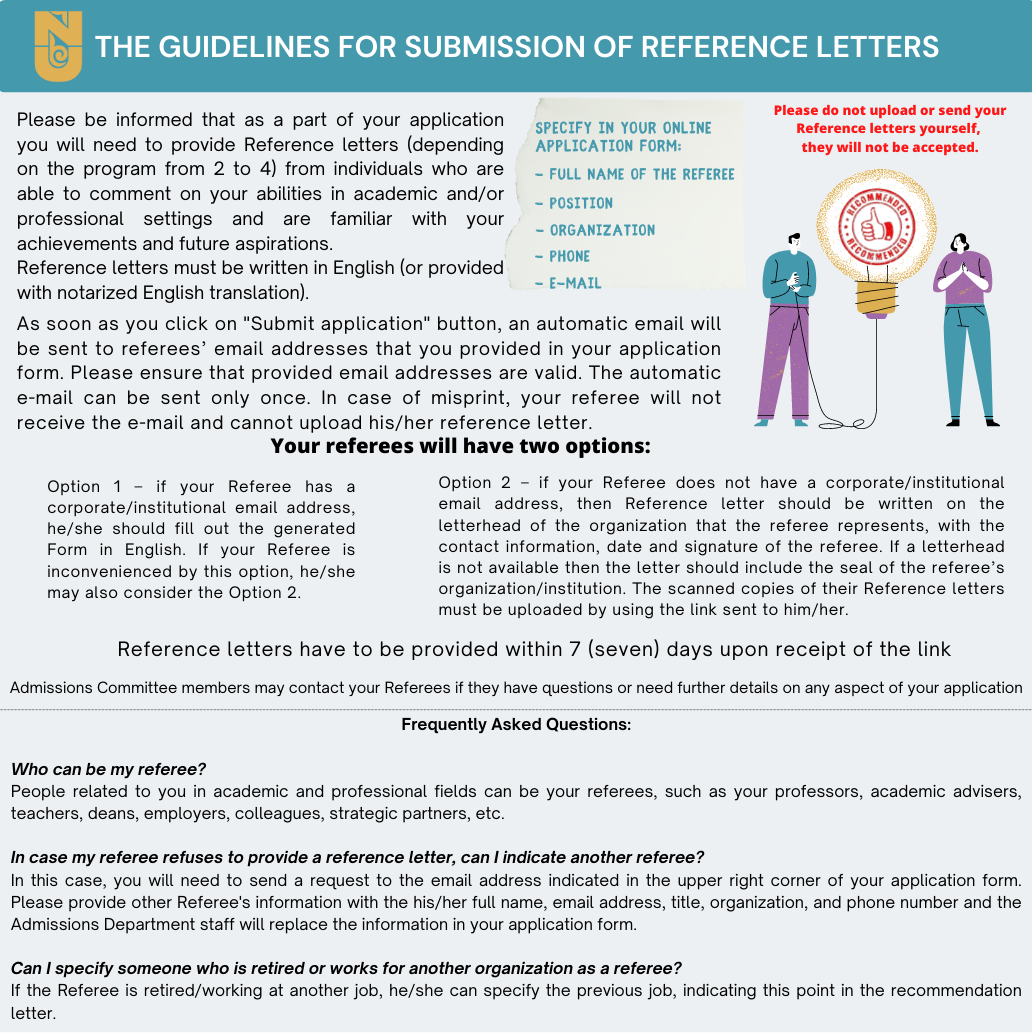
7 | Letters of recommendation | Two confidential letters of recommendation written within the last 12 months (to be provided by referees electronically or in hard copy). You can find the Instructions for submission of recommendation letters here; |
8 | CV | A CV up to 1 page. |
Minimum requirements:
1) Undergraduate and Master's degrees (or equivalents). During the application period, final-year master's students may submit an official current transcript for consideration;
2) A minimum CGPA of 2.75 out of 4.00 in an applicant’s master’s degree. The Admissions Committee can consider the graduates of highly ranked universities with CGPA of 2.5 out of 4.0;
3) English proficiency:
3.1) Overall IELTS test score of 6.5 (with sub-scores no less than 6.0) or the equivalent TOEFL score as posted on the ETS website. For the PhD in Eurasian Studies program, overall IELTS test score of 7.0 (with sub-scores no less than 6.0) or the equivalent TOEFL score as posted on the ETS website.TOEFL iBT Home Edition, TOEFL PDT, IELTS Online and IELTS Indicator results are not accepted;
3.2) Applicants can be exempted from submitting the language proficiency test report if:
- one of their earlier academic degrees was earned in a country with English is the language of official communication and academic instruction;
- an undergraduate and/or graduate degree was earned in a program that was officially taught in English;
4) Strong reading, analytical, and mathematical skills as demonstrated by GRE test (recommended);
5) A high level of motivation and strong interest in the program as outlined in a personal statement;Application package checklist:
All submitted documents shall be in English or with notarized English translation:
- Complete Application form;
- Scanned copy of national ID (for the citizens of the Republic of Kazakhstan) or passport (for international applicants);
- Scanned or electronic copy of an official document confirming name change (if applicable);
- Degree diplomas (Bachelor’s and Master’s or equivalents) with transcripts; During the application period, final year master's students may upload official current transcript for consideration;
- An official electronic IELTS/TOEFL certificate (valid at the time of document submission) sent to the University through IELTS/TOEFL VERIFICATION SERVICES. Code for IELTS: NU. Code for TOEFL: 6762;
- Document confirming English as the language of instruction (only for applicants who earned their degree in a program which was taught in English and request an exemption from submitting IELTS/TOEFL). Applicants should provide a detailed certificate/reference from the university indicating the number and list of subjects completed in English;
- GRE or GMAT certificates valid as of date of online documents submission (recommended);
- Statement of purpose - A high level motivation and a strong interest in the Program, as outlined in a statement of purpose.
- Two confidential letters of recommendation written within the last 12 months (to be provided by referees electronically or in hard copy). One of the two recommendations shall be written by a current or previous employer or research supervisor. You can find the Instruction for submission of recommendation letters here;
- CV (up to one page).
Deadline for full tuition fee-paying applicants:
- For international applicants with visa required prior to arrival: June 1, 2026, 2 pm (Astana time);
- All other applicants (local and international): July 17, 2026, 2 pm (Astana time).
- for international applicants: March 17, 2026;
- for the citizens of the Republic of Kazakhstan: March 30, 2026.
The deadline for submission of IELTS/TOEFL, GRE/GMAT certificates:
For full tuition fee-paying category:
- For applicants from countries requiring a visa prior to arrival: June 1, 2026;
- For other applicants (local and international): July 17, 2026.
- for international applicants: March 17, 2026;
- for the citizens of the Republic of Kazakhstan: April 8, 2026.
First day of classes: August 2026
To learn more about tuition fees, please contact us at bursars_office@nu.edu.kz.
There are merit-based “Abay Kunanbayev” scholarships for top international applicants recommended for admission.
Take the first step.
Fill out the form to start the conversation, and one of our program specialists will follow up with you directly. You'll also receive a link to download our guides and program information emails.